Focusing in on workplace violence-related reports
14 July 2026
In recent years, various data sources1 show that violence within transport networks has increased. A survey of 6,000 railway workers conducted by the trade union RMT found that 63% of staff had experienced violence at work. Following a recent survey of TSSA union reps that asks about experiences of workplace violence, the union has stated the situation is “out of control”. Meanwhile, the British Transport Police (BTP) records that almost all train operating companies have seen an increase in violence towards staff in the past year2 and this is also true for many stations.
At CIRAS, we have seen an increasing trend in reporters concerned about the risk of violence at work between April 2020 and March 2026. In total, we have processed 57 concerns relating to this during this time. Some of the 2025 concerns came through in the wake of the mass stabbing incident on the East Coast mainline in November 2025.
While our numbers are small compared to other datasets, they provide valuable insight into the perspectives of frontline staff.
“A colleague has been grabbed by the collar. I’ve been threatened with a knife.”
“One of the team was assaulted after challenging someone who didn’t have a ticket.”
“You feel vulnerable when there on your own. You worry you could be assaulted.”
The reports we have received relate to risk across the UK and the Republic of Ireland. Most reports (87%) focused on England, where risk was seen in many locations including at railway stations, on buses, and in station car parks. Our data indicates that the locations where most reporters are concerned about violent incidents are on board transport and at stations/transport hubs. This also reflects the BTP data of recorded crimes being highest on board transport, and then in railway stations .
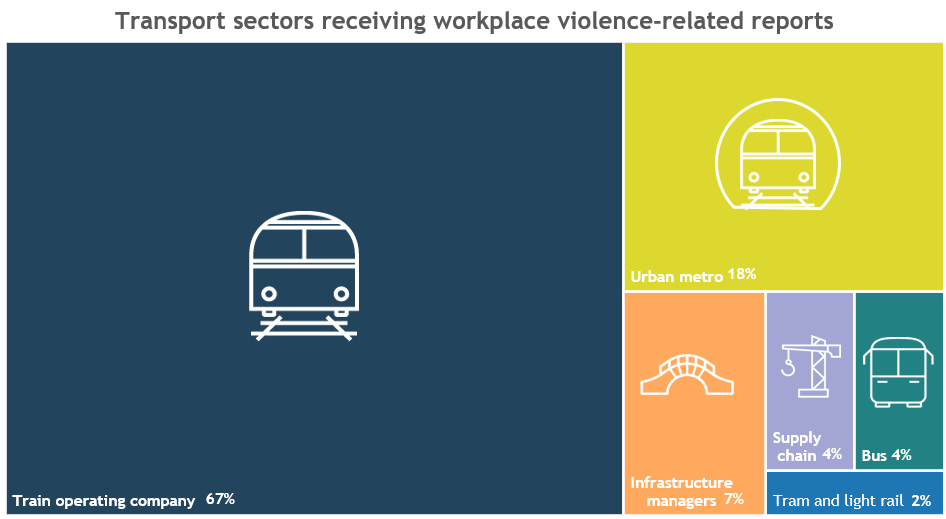
Our data shows that train operating companies are the most likely to receive a CIRAS report on workplace-related violence (67%). This is followed by urban metro transport systems (18%).
People raise a wide range of workplace-related violence concerns with us. Some are about threats to personal safety due to general antisocial behaviour that certain locations may attract: for example, late night transport services or poorly lit station car parks.
Other reports mention fears that due to service quality, issues such as lack of working toilets on board a train or late running, crowded routes, passengers can direct frustration towards staff. This may be verbally or physically abusive.
There is also concern about risks to personal safety when lone working, particularly at night or during other hours of darkness. The most common aspect of workplace violence raised with CIRAS has been the risk of assault or abuse, followed by concerns about antisocial behaviour, including intoxicated customers and members of the public carrying weapons.
Most workplace violence reports come from station staff (40%), which is unsurprising given the prevalence of concerns about risks of violence in stations/transport hubs. These sorts of concerns can relate to enforcement-linked issues, such as fare evasion and gate line challenges; security concerns about access to restricted areas; or concerns about places of safety for staff if facing attack from a member of public.
Across all our workplace violence-related reports, our data suggests that those with less time in role are more likely to report to CIRAS, with over three-quarters of reporters having less than 10 years’ service. On the other hand, only 4% of reports came from those with more than 30 years’ service.
A reporter raised concerns about cleaning operatives being required to work alone at unstaffed railway stations. There was fear that this placed them in vulnerable situations with increased personal safety risks and limited access to secure areas. Lone working also means operatives may be the only visible staff presence, potentially exposing them to aggression from members of the public. Additional risks were identified around hazardous materials, as operatives could not safely manage sharp objects found during cleaning due to restricted access to disposal facilities.
New measures were introduced to:
A reporter raised concerns about risks to staff and passenger safety linked to the removal of disruptive or abusive passengers from trains, focusing on unclear communication around where this can safely take place. The reporter described confusion over updated procedures, limited police presence at some locations, and the potential for prolonged exposure to risk on long routes with few suitable stations. These issues were said to increase the likelihood of assaults and create uncertainty for frontline staff.
Actions were taken to:
When we asked reporters to CIRAS if they felt there had been action taken since they had raised their concern about workplace-related violence, over one-third said yes. Here are some quotes from them:
“The report provided to the company was very good and I’d definitely use CIRAS again.”
“I am most pleased with the work CIRAS has done. Thanks for your help.”
“I returned to CIRAS because of the expertise, accuracy, professionalism and speed my concerns were dealt with.”
If you have a workplace violence-related safety concern that you wish to raise confidentially, contact us. We will listen and raise the concern with the relevant company.
Violence at work is never normal
Webinar: tackling work-related violence
PTSD: getting help after trauma
How to get rail safety back on track [IOSH]
Acting on Assaults [RMT]
Violence against transport workers is 'out of control' says TSSA [TSSA]
Crime stats and data [BTP]
Union calls for action on bus driver assaults [BBC News]
Action urged over violence against transport staff [BBC News]