
Who is reporting their fatigue concerns to us and why?
11 January 2024
Fatigue doesn’t make up a big share of the reports we receive. It remains consistently at around 10% of CIRAS reports each year. There were 59 CIRAS reports about fatigue from the start of the 2021/22 financial year to period 7 of the 2023/24 financial year (about halfway through the year, in October). Fatigue accounted for 11% of all CIRAS reports during that time.
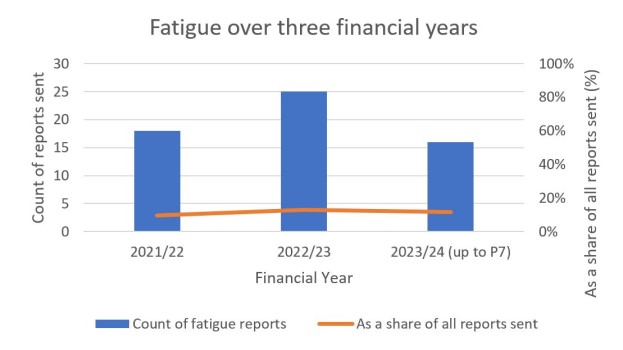
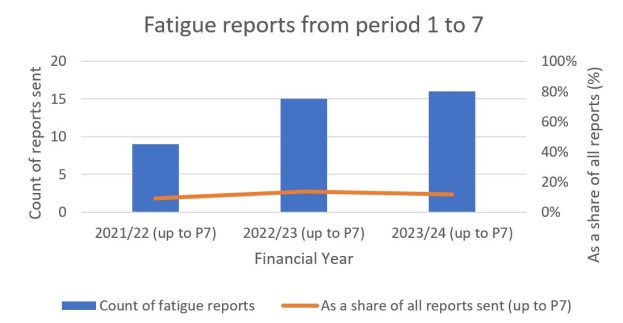
By period 7 of 2023/24, we had sent slightly more fatigue reports to our member companies than in the same period of time in previous years. Could we see more fatigue reports by the end of 2023/24 than we did in 2022/23?
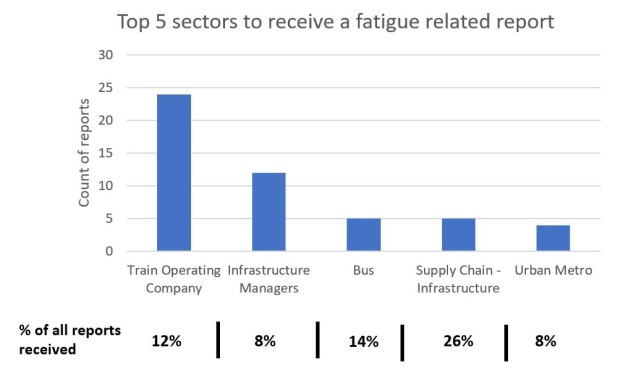
The graph below shows that train operating companies (TOCs) have received the most fatigue-related CIRAS reports by count, but the table underneath it shows that, as a share of all reports received, fatigue only makes up 12% of reports for TOCs. Compared with TOCs, the supply chain has far fewer CIRAS reports about fatigue, but a higher proportion of the CIRAS reports it receives are about fatigue (26%).
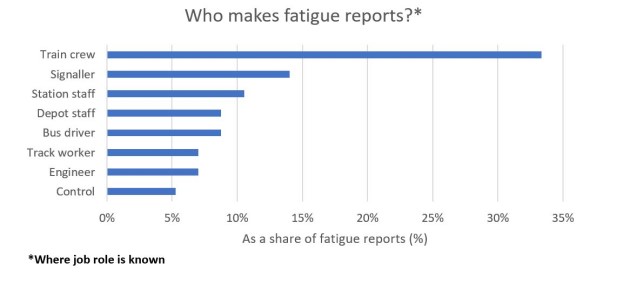
Despite train crew frequently reporting on fatigue, fatigue does not constitute a significant portion of all reports made by this group of staff (13%). In comparison to other job roles, reports of fatigue were most prevalent among signallers, accounting for 33% of the reports they made.
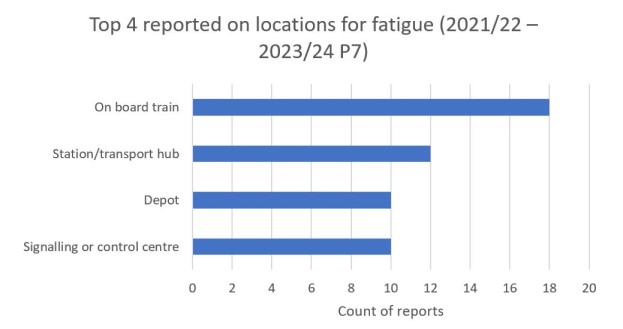
This represents reporters concerned about their ability to focus while driving a train or dispatching services.
In these reports, reporters to CIRAS were concerned that station-based staff were not getting adequate breaks due to new or revised rosters. Some of the reports have also been about the workload negatively impacting on staff being able to take breaks.
Similarly, fatigue reports related to depots were concerned with under-staffing, and that an inability to control workload meant that depot-based staff were becoming fatigued.
Fatigue reports related to signalling or control centres were almost all about signallers not being able to take breaks due to low staffing levels, including not having enough staff to relieve others so that they could take breaks. Reporters were concerned that signallers being fatigued could contribute to a train accident.
CIRAS reports can be tagged with more than one of our themes. Analysis shows that fatigue is often tagged alongside other themes such as those shown in the graph below: health and wellbeing, rules and procedure, equipment, and the person’s environment.
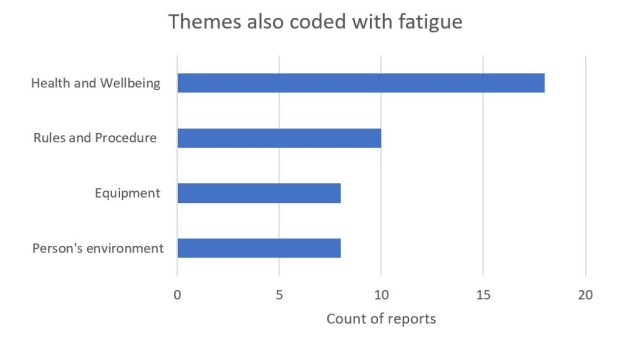
Health and wellbeing is the theme coded together with fatigue most often in our reports. The conditions that contribute to fatigue can negatively impact the health and wellbeing of staff in other ways. But not every reporter who raised a concern about fatigue expressed concerns for their wellbeing or health.
The type of reports we coded with both fatigue and the health and wellbeing theme included those about staff feeling pressured to keep up with workload, and concerns over poor working conditions that could negatively impact health and wellbeing, such as not being able to take personal needs breaks.
Reports where the equipment and person’s environment themes are coded with fatigue show that external conditions – typically temperature – can contribute to fatigue, and so these conditions need to be controlled for, typically using equipment. Examples included reports where faulty or ineffective air conditioning on trains or buses meant on-board temperatures could not be controlled and so drivers were feeling fatigued.
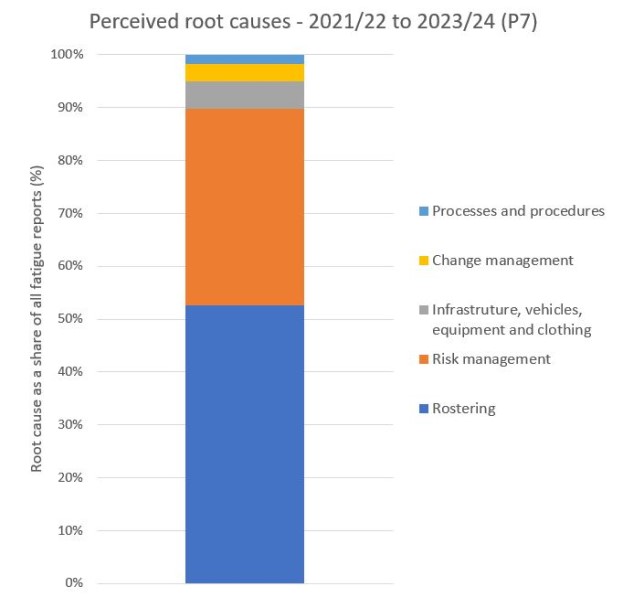
Reporters tell us their view of the root cause of their concern, and we classify these as set out above.
To no surprise, most CIRAS reports about fatigue in the time period covered by this article had a root cause that we classified as rostering. In more detail, this included the design of shifts, or when the reporter believed there was an insufficient number of staff on the roster.
Risk management was the second most associated root cause with our fatigue reports. Reporters explained that fatigue had been reported internally, but they believed the issue had not been adequately resolved.
Cost-cutting measures are also included in the risk management root cause classification. In instances where cost-cutting was mentioned, reporters felt that cost-cutting measures were contributing to conditions that might lead to fatigued staff. For example, air conditioning not being replaced or fixed in time for upcoming hot weather, and companies not being able to recruit for more staff due to financial constraints.
CIRAS reports – Search our reports for fatigue concerns
Fatigue risk, prevention, and why fatigue matters in transport
Change to Network Rail’s fatigue standard (includes a link to our webinar about preparing for the changes)
UK Tram: innovating to prevent fatigue events
Alstom: fatigue management and sleep quality